

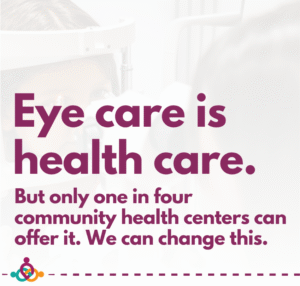
 Community Health Centers (CHCs) arose to provide primary healthcare services to the nation’s most vulnerable and medically underserved populations, regardless of their ability to pay. Yet only 1 in 4 (26%) CHCs nationwide offer vision services through an optometrist or ophthalmologist, and a mere 3% of the 34.5 million patients they serve annually can access them due to a multitude of systems-level barriers.
When trying to establish or expand these services, health centers face high start up costs, space limitations, workforce challenges, and more due to the exclusion of vision services from the mandated scope of primary medical services under Section 330 of the Public Health Services Act, limited coverage under Medicare, state variances in Medicaid coverage for adults, and eye care providers’ exclusion from the National Health Service Corps.
The Association of Clinicians for the Underserved’s (ACU) white paper, A Roadmap for Community Health Centers to Establish and Expand Comprehensive Vision Services, provides an overview of the efforts over the last two decades aimed at addressing these challenges, and recently there has been a significant increase in activity aimed at expanding access to vision services through health centers. With the generous support of the Lavelle Fund for the Blind, ACU will conduct the first ever in-depth scan of national and state-level organizations working to expand access to vision services via CHCs with the goal of identifying opportunities for coordination and alignment of activities, as well as new synergies between organizations.
Starting in March 2026, the scan will delve into these organizations’ current efforts, future goals, and gaps. Upon completion of the scan, ACU will synthesize this information into a draft report that summarizes recommended next steps, goals, and milestones across the following five areas:
- Communications – Establish communication channels to disseminate resources and information developed by the coalition and participating organization
- Workforce & CHC Implementation – Develop a national strategy for supporting a thriving and sustainable eye care workforce, including pipeline development, recruitment & retention strategies, staff development and advancement, well-being initiatives, and ongoing workforce assessment, as well as a strategy for educating and supporting CHC leaders and staff
- Research and Data – Develop a set of research priorities that align with Healthy People 2030 objectives and demonstrate the value CHCs offer by improving access to vision services
- Better Use of Technology, AI, and Mobile Health Solutions: Develop and/or disseminate guidance and recommendations for improving access to vision services through better use of technology, AI, and mobile health solutions at CHCs
- Policy & Advocacy – Create educational resources and facilitate dialogue on federal- and state-level policies that support or create barriers to providing eye care at CHCs
This report will be the foundation for establishing a national coalition that focuses singularly on improving access to vision services in all underserved communities. For more information about these efforts, please contact ACU Program Director Luke Ertle.
