


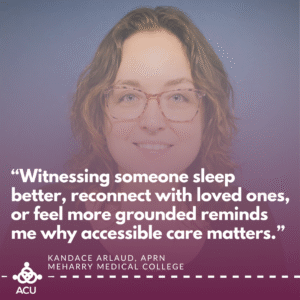
Five Questions With Kandace Arlaud, APRN
Highlighting ACU Members Advancing Care in Underserved Communities
As part of ACU’s Five Questions With… spotlight series, we’re highlighting the dedicated ACU Members whose leadership and lived experience help advance compassionate, community-centered care. This series offers a closer look at the people behind the work, what motivates them, what they’ve learned, and why serving underserved communities remains at the heart of their careers.
In this edition, we’re honored to feature Kandace Arlaud, APRN, Psychiatric Nurse Practitioner at Meharry Medical College and a member of ACU’s Membership Committee. Kandace leads programs focused on expanding access to coordinated behavioral health and substance use services. Her work reflects a long-standing commitment to community-based practice and addressing system-level barriers to care. She has contributed to initiatives improving referral coordination, enhancing transportation access, strengthening behavioral health integration, and connecting patients to essential resources. Kandace’s scholarly interests include clinician burnout, workforce sustainability, and innovations in nursing education. She is completing her Doctor of Nursing Practice and is a recipient of HRSA’s STAR program supporting clinicians in high-need settings.
Tell Us About Yourself
I’m a Psychiatric Nurse Practitioner and Treatment Director at Meharry Medical College, where I oversee an outpatient program centered on providing consistent, accessible behavioral health and substance use services. I grew up in a rural area where healthcare was scarce, and as a new nurse, I often found myself meeting people where they were, as I literally drove out to communities that rarely saw a provider. Those early experiences stayed with me. They shaped my decision to continue my education step by step from community college to my bachelor’s degree, to graduate school, and now to my DNP with each step fueled by wanting to understand how to build care systems that truly reach people. Outside of work, I live in rural Tennessee, grew up in a traveling military family, and am now raising my three children, ages 5 to 16, while enjoying time outdoors with our dog and cats.
Why Did You Choose to Focus on Caring for Underserved Communities?
During my early career in rural and resource-limited settings, I met patients who had gone years without treatment simply because services were too far away or too difficult to navigate. What struck me most was that many people weren’t avoiding care, but they were trying to survive within systems not designed for their realities. Those experiences created a lasting commitment to designing clinical environments that are approachable, practical, and welcoming from the very first interaction.
“What struck me most was that many people weren’t avoiding care, but they were trying to survive within systems not designed for their realities.”
What Motivates You in Your Day-to-Day Work?
I’m motivated by the resilience I see every day. Many of our patients are managing complex challenges, yet they show up and keep trying. Witnessing someone sleep better, reconnect with loved ones, or feel more grounded reminds me why accessible care matters. My team motivates me as well as they work hard to create a stable, predictable environment where patients feel safe and supported. Their dedication makes meaningful progress possible.
What Does ACU Mean to You?
ACU represents a community of professionals across the country who share a commitment to expanding access to healthcare in places where it’s needed most. It’s a space where people exchange practical solutions, support each other, and strengthen programs serving communities with significant access challenges. Being part of ACU keeps me connected to innovative ideas and reinforces the importance of building care models that work for both rural and urban populations.
“Being part of ACU keeps me connected to innovative ideas and reinforces the importance of building care models that work for both rural and urban populations.”
What Would You Like People to Know About Underserved Communities and Their Health Needs?
People who face barriers to care often deal with challenges that have nothing to do with motivation but instead include transportation, work obligations, limited resources, or prior negative experiences in healthcare. Their needs are the same as anyone else’s; the difference lies in how complicated it can be for them to receive support. When services are designed to be straightforward, respectful, and responsive to real-life circumstances, people engage more consistently and experience better outcomes. Even small adjustments in how care is delivered can make a significant difference.
Get Involved with ACU
Kandace’s work highlights the power of meeting people where they are and designing care systems that respond to real-life challenges. Through its trainings, advocacy, and professional community, ACU brings together clinicians and leaders committed to expanding access to practical, compassionate care in communities with the greatest need.
Interested in getting involved with ACU? Learn more about membership, explore benefits, and discover opportunities to connect, lead, and grow within the ACU community.
